


 Eric J. Topol, MD
 Ania M. Jastreboff, MD, PhD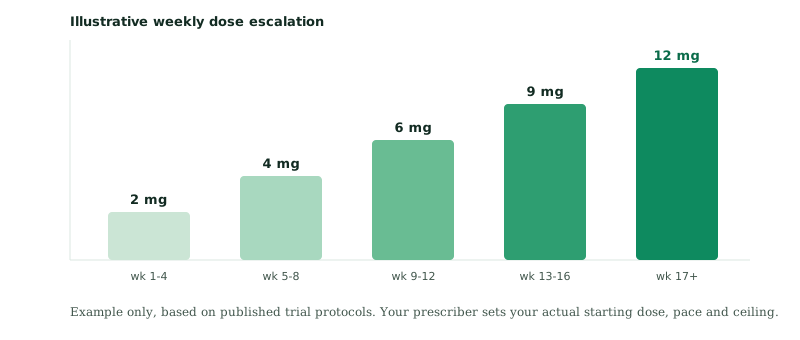
To understand retatrutide dosage, start with this: it is an investigational compounded peptide, and the correct amount for any individual is decided by a licensed prescriber, not a chart. Retatrutide has not received FDA approval. This page explains how retatrutide dosing is usually structured in clinical studies and by telehealth services, why the gradual increase is important, and how a milligram prescription converts to the 'units' you measure on a syringe. Consider this educational content, not tailored medical guidance. Your clinician sets your first dose, how quickly it rises, and the maximum amount.
Key points about retatrutide dosing
- Administered as a subcutaneous shot once weekly on the same day.
- Studies usually initiated at a low dose (frequently about 2 mg weekly) and increased on a monthly basis.
- Research protocols examined maintenance doses up to roughly 8 mg and 12 mg per week.
- The milligram amount is determined by your doctor; syringe 'units' depend on how the compound was prepared.
- Retatrutide is investigational and compounded, and it requires a prescription.
Initial retatrutide dose and the rationale behind slow titration
A conservative starting amount is primarily due to the gastrointestinal system. Retatrutide affects GLP-1, GIP, and glucagon receptors, and the GLP-1 component is especially known to cause nausea, reflux, and other digestive side effects if the body is exposed to a new dose too rapidly. A gradual increase allows the digestive tract to adapt, often making these adverse effects less severe and more manageable.
In clinical trials, participants often began at about 2 mg weekly and stayed at that level for four weeks before any upward adjustment. Some telehealth plans start even lower. The objective of a slow schedule is not to escalate quickly to high amounts; it is to identify the smallest effective dose that is also well tolerated. Not everyone requires the maximum studied dose.
A sample retatrutide dose escalation table
The following retatrutide dosage plan is a representative schedule based on how trials and many compounding-pharmacy protocols implement a gradual monthly increase. This is merely an example and not a prescription; it does not indicate what you should take. Your clinician will design your personalized retatrutide dosing plan according to your reactions, tolerance, and objectives.
| Weeks | Dose (mg/week) | Notes |
|---|---|---|
| 1–4 | 2 mg | Initial period when the body adapts to the peptide. |
| 5–8 | 4 mg | First increase if the starting dose is well tolerated. |
| 9–12 | 6 mg | Some individuals reach their effective maintenance amount at this level. |
| 13–16 | 8 mg | Higher maintenance dosage range assessed in studies. |
| 17+ | up to 12 mg | Maximum research dosage range; considered only if your clinician deems it necessary. |
What amount of retatrutide is right for me?
There is no universal dosage that suits everyone. The straightforward answer is that your dose is what your prescriber determines after assessing your medical history, other medications, and your initial response over several weeks. Two individuals of similar body weight may have very different maintenance doses. To see a possible titration pattern, our retatrutide dosage calculator You can outline a possible plan to talk over with your clinician—this is not a replacement for their expert judgment.
How retatrutide is measured in units versus milligrams
Here is where most mix-ups occur. Your provider writes the dose in milligrams, but an insulin-type syringe shows units. Those units count volumevolume, not the amount of drug: on a typical U-100 syringe, 100 units equal 1 mL. So a 4 mg dose could be a very different number of units depending on how strong your vial is, which is set by reconstitution.
Before these numbers matter, the freeze-dried powder needs mixing. Check our tutorial on reconstituting your vial with bacteriostatic water for the exact process—the volume of water you use determines the concentration, and thus the retatrutide dose in mL and units.
Example dose conversion table
The chart below shows how a set vial strength becomes units with different water volumes. These are just samples to show the math, not directions for your particular vial.
| Vial | BAC water added | Concentration | 2 mg dose | 4 mg dose |
|---|---|---|---|---|
| 10 mg | 1 mL | 10 mg/mL | 0.20 mL = 20 units | 0.40 mL = 40 units |
| 10 mg | 2 mL | 5 mg/mL | 0.40 mL = 40 units | 0.80 mL = 80 units |
| 30 mg | 3 mL | 10 mg/mL | 0.20 mL = 20 units | 0.40 mL = 40 units |
Guidelines for taking retatrutide safely
After mixing, the medicine is given under the skin in the abdomen, thigh, or upper arm. For proper method—rotating sites, removing bubbles, needle position—see our guide on how to inject retatrutideNever share pens, needles, or vials, and keep the vial as your pharmacist instructs.
How often to dose, if you miss a dose, and long-term use
Why retatrutide is given once a week
Retatrutide has a long half-life, around six days according to early research. Dosing once a week keeps levels fairly even between injections without needing daily shots, which is why most retatrutide schedules stick to a single set day each week.
Pick a consistent day
Pick one day of the week and stay with it. A consistent interval helps maintain stable levels and makes a missed dose simpler to notice.
Handle a missed dose appropriately
Many plans say that if you realize within about 1–2 days, you can take it and then go back to your usual schedule; if the next dose is near, skip it and continue. Never take double. Check what your clinician advised.
Hold at a maintenance dose
If you find a dose that works well and causes only mild side effects, you may stay at that level instead of increasing to the highest one. The goal is to use the lowest amount that still works.
Maintenance vs maximum dose
Maintenance and maximum mean different things. The maximum studied weekly retatrutide dose reached the upper end of the chart above, but once weight and appetite are stable, most people are managed at a lower maintenance amount. Aiming for the highest dose rarely brings better results and often leads to more side effects.
Uncertain about the right starting point for a safe, medically supervised plan? Answer the intake questions, and a licensed clinician will check if you qualify.
Get startedWhen your clinician changes your dose
A retatrutide dosing schedule is not fixed. Doctors often lower, pause, or delay increasing a dose if nausea or other side effects are difficult to cope with, if weight loss is happening so quickly that it needs monitoring, or if other health issues come up. They may keep you on one step for an extra month instead of increasing as planned. They may also stop raising the dose early if you are responding well. Always attend check-ins, be honest about side effects, and never change your own dose to make up for missed ones. To see what a realistic response looks like in the first months, refer to our weight-loss timeline.
Retatrutide dosage FAQ
What is a common starting dose for retatrutide?
Many studies and treatment plans begin at about 2 mg once a week, kept for around four weeks before any increase. Some telehealth programs start with a lower amount. Your doctor decides your actual initial dose.
How can I change my retatrutide dose from milligrams to units?
Units measure volume, which depends on the concentration. To find mL, divide your dose in milligrams by the concentration in mg/mL. Then multiply that result by 100 to get the number of units on a U-100 syringe. Double-check with your pharmacy.
What is the highest weekly dose of retatrutide?
In research, maintenance targets went up to around 8 mg and 12 mg per week, but most people are kept on a lower dose for maintenance. The maximum is not a target to aim for.
What should I do if I forget a weekly dose?
As a general rule, you may take the missed dose if it is within about 1–2 days and then continue your normal schedule. If the next dose is soon, you might skip the missed one. Never take two doses at once, and always follow the specific instructions from your doctor.
Is there an official dosing chart for retatrutide?
No. Since retatrutide is still being studied and is not approved by the FDA, there is no official chart included in the label. Any chart, including the one on this page, is only an example to discuss with a licensed prescriber.
Can I use a dosing chart I found on the internet?
No. Charts differ depending on the bottle strength and how the peptide is mixed, and self-dosing is dangerous. Use only the dose and concentration that your clinician and pharmacy have confirmed for your specific vial.