


 Rhonda Patrick, PhD
 Ania M. Jastreboff, MD, PhD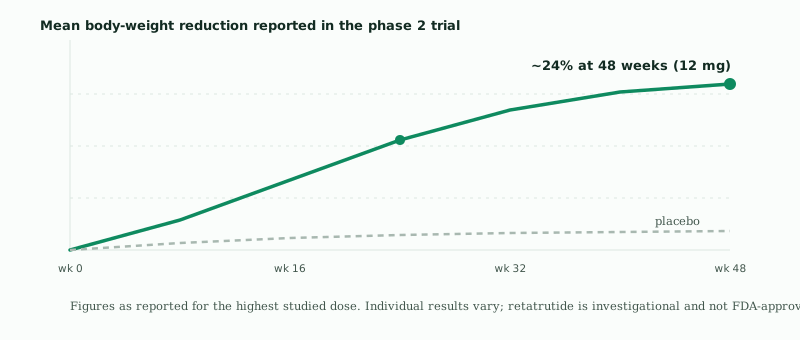
Online searches for retatrutide and bodybuilding have surged, but much of this interest stems from a common misconception that needs addressing upfront: retatrutide is not an anabolic agent. It is an investigational peptide that targets three receptors (GLP-1, GIP, and glucagon) and is being studied for weight loss. Its mechanism does not trigger muscle growth. Instead, it reduces body weight, and any significant weight loss, regardless of method, inevitably involves losing some lean mass along with fat. This trade-off is the main focus of this page.
Quick orientation: Retatrutide is not FDA-approved for any indication. In the United States, it is only available as a compounded product prescribed by a licensed healthcare provider. It has never been approved, studied, or marketed for athletic performance, physique enhancement, or bodybuilding. The information provided here is not a protocol nor an endorsement of off-label use.
If you are wondering whether retatrutide can help you become leaner while preserving your muscle, the straightforward answer has two parts. It can significantly reduce fat mass. However, it will not build muscle, and without intentional effort, you will likely lose some. The remainder of this page explains why and what the evidence suggests you can do about it.
Does retatrutide build muscle? The short answer
No. There is no mechanism by which retatrutide could enhance muscle protein synthesis. Its three receptor targets influence appetite, gastric emptying, insulin secretion, and liver energy metabolism—pathways that lower calorie intake and increase energy expenditure. None of these interact with the androgen receptor, growth hormone pathways, or the mechanical tension signaling that truly drives muscle growth.
Is it possible to build muscle while taking retatrutide?
Theoretically, yes, but only due to your own efforts, not the drug's effects. Gaining muscle during a calorie deficit is feasible under specific conditions: beginners in resistance training, those returning after a prolonged break, and individuals with substantial excess body fat. These groups may experience body recomposition, adding lean tissue while losing fat. However, a seasoned lifter near their genetic potential, in a deep deficit and using an appetite suppressant, does not fit this profile. For them, the realistic objective is preservation rather than gain.
Why the glucagon component is not an anabolic signal
Retatrutide's glucagon receptor activity sets it apart from dual or single agonists and is believed to contribute to increased energy expenditure and effects on liver fat. 'Increased energy expenditure' is sometimes misconstrued online as a metabolic advantage for bodybuilding. This is incorrect. Burning more calories at rest supports fat loss, not muscle gain, and glucagon signaling in the liver has no established role in skeletal muscle hypertrophy.
What 'lean mass' truly means in body composition scans
Discussions about retatrutide's impact on muscle mass often falter due to definitional confusion. When a DEXA scan or bioimpedance device indicates a decrease in 'lean mass,' this figure does not measure muscle specifically. Fat-free mass encompasses various components that predictably decline during weight loss and are unrelated to contractile tissue.
The first components to decrease
Muscle stores glycogen, and each gram of glycogen is bound to roughly three grams of water. When carbohydrate intake drops—which often occurs with reduced appetite—glycogen and its associated water are lost rapidly. Total body water also decreases as food and sodium intake fall. Furthermore, sustained weight loss reduces connective tissue, blood volume, and even organ mass that previously supported a larger body. All these changes are reflected as lost lean mass on a scan.
This has practical implications: a scan taken two weeks into treatment may show a concerning drop in lean mass that is largely water and glycogen. Re-scanning after weight has stabilized and hydration is consistent offers a more reliable assessment than a single early measurement.
What trial data revealed about body composition
Body composition sub-analyses from retatrutide's obesity trials indicated that a significant portion of total weight loss was fat mass, while a smaller proportion was fat-free mass. This is broadly similar to findings with other incretin-based drugs and typical dietary weight loss. These were secondary outcomes in a subset of participants, measured over a defined period, and should be interpreted as indicative rather than a guarantee for any individual. We deliberately avoid citing exact percentages because figures circulating in forums are often misattributed or based on studies of different medications. Consult a qualified clinician for accurate published data. Our overview of weight-loss results provides more details on the primary endpoints.
Does retatrutide cause muscle loss, or is it the calorie deficit?
This is a critical distinction often overlooked. There is no evidence that retatrutide directly breaks down skeletal muscle. Its primary effect is appetite suppression, which paradoxically makes two key muscle-preserving behaviors more challenging to maintain.
The protein problem
Protein is the most satiating macronutrient, which is beneficial when trying to eat less, but it becomes a hurdle when you need to meet protein targets despite a diminished appetite. Many individuals on incretin therapy find meat less appealing, and delayed gastric emptying makes large meals uncomfortable. As a result, protein intake often drops proportionally with total calories, or even faster. Inadequate protein during a calorie deficit is a well-established contributor to lean tissue loss.
The training problem
The second factor is the lack of a stimulus that signals the body to retain muscle. Resistance training provides that signal. Without it, the body has no metabolic incentive to maintain costly tissue. Fatigue, nausea, or low energy during the initial weeks—see our page on nausea and other common effects —can cause training to fall by the wayside precisely when it is most crucial.
In the reported studies, strength and functional capacity changes were evaluated as trial endpoints rather than self-assessed by patients.
Common questions about retatrutide and muscle mass
Can retatrutide contribute to muscle gain?
No, it does not possess anabolic properties. Some users say they feel stronger in relation to their body weight after fat loss, which enhances performance in bodyweight exercises, but this is due to reduced weight, not increased muscle.
Does retatrutide protect muscle more effectively than other weight-loss medications?
There is no direct comparative evidence to support that assertion. Body composition outcomes among incretin-based drugs have been generally comparable, and the online comparisons are not based on clinical trials designed to address this issue.
What protein intake is recommended during treatment?
This is a personalized medical question. Protein requirements during weight loss are typically higher per kilogram of body weight than during weight maintenance, but the exact amount depends on your muscle mass, kidney health, and other factors. Consult a physician or registered dietitian to determine the appropriate level.
If I discontinue treatment, will the lean mass lost come back?
Regaining weight after stopping usually includes both fat and lean tissue, but the regained composition is often less favorable than what was lost, especially without resistance exercise. After treatment, maintaining a training routine and sufficient protein intake is the primary factor you can influence.
Is it possible to train intensely during dose escalation?
Many individuals find intense exercise challenging in the early weeks after increasing the dose due to nausea and lower food intake. Temporarily reducing training volume while remaining consistent is often more effective than taking a complete break. Consult a clinician about any severe symptoms.
Is it legal to use retatrutide for bodybuilding purposes?
Retatrutide is not FDA-approved and is not available for enhancing performance or physique. In the US, it can only be obtained through a licensed provider as a compounded medication for a legitimate medical condition. Purchasing it outside this framework poses legal, purity, and safety dangers.
Medical disclaimer: This page provides educational content only and is not medical advice. Retatrutide is an investigational agent, not FDA-approved, and has not been studied for use in healthy people aiming to alter body composition or athletic performance. Always discuss any weight-loss therapy, supplement, or exercise regimen with a clinician who is aware of your health history.